Rain Walking Flat Color Vector Character
A Designer’s First Look: Charm with Quiet Clarity
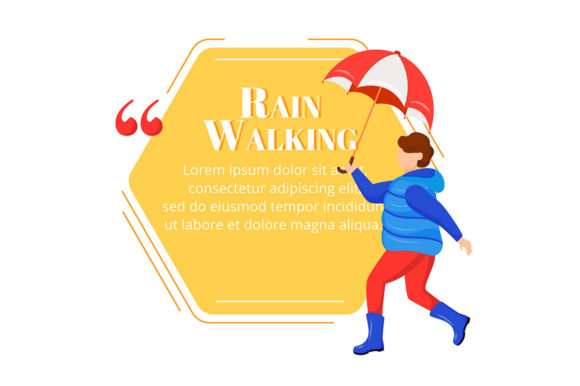
When I opened the Rain Walking Flat Color Vector Character, my immediate thought wasn’t “cute” — it was “clear.” The child in gumboots, umbrella tilted just so, coat flaring slightly — all rendered in flat color with clean, uncluttered outlines — lands with gentle confidence. There’s no visual noise, no competing textures or gradients. That simplicity isn’t minimalism for its own sake; it’s purpose-built for translation into thread. As an embroidery designer who’s stitched hundreds of character-based designs onto everything from baby onesies to boutique aprons, I appreciate how this design avoids pitfalls: no tiny facial features that vanish under satin stitch, no overlapping limbs that cause registration headaches, and no fine linework that frays or breaks on lightweight fabric.
Where It Shines: Real Projects, Real Stitching
I tested Rain Walking Flat Color Vector Character as the centerpiece for a custom embroidered tote bag — the kind sold at local craft fairs and stocked in small gift shops. On medium-weight canvas, with light tear-away stabilizer and standard 40-weight poly thread, the shape held beautifully. The silhouette reads instantly at 3.5 inches wide — large enough for impact, small enough to sit comfortably near a strap or pocket. It also translated well onto a soft cotton sweatshirt (using cut-away stabilizer), where the flat-color approach meant no muddy fill-stitch transitions or haloing around edges.
This design naturally fits baby embroidery projects — think onesies, burp cloths, or nursery pillow covers — because the mood is tender but not saccharine. It works equally well for holiday embroidery (a rain-themed Christmas gift for a teacher who loves gardening) or personalized gifts (a custom tea towel for a friend who always walks in the rain with her dog). For Etsy sellers and small shop owners, it’s a quiet standout: not loud enough to overwhelm, but distinctive enough to build brand consistency across a line of weather-themed kitchen textiles or children’s apparel.
What Holds It Back — And When to Pause
That same clarity becomes a limitation in certain contexts. On highly textured fabrics — like terry cloth towels or bouclé knit caps — the clean lines can get visually lost. I wouldn’t recommend it for curved surfaces like baseball caps without first testing placement and stitch tension; the umbrella’s straight edge and the boy’s coat hem need stable, flat real estate to read cleanly. Also, while the speech bubble and blank frame template are clever for adding custom quotes, those elements demand extra attention: tiny text inside the bubble will require careful digitizing or manual editing before stitching — don’t assume the included vector translates directly into legible running stitch.
On dark fabric, contrast matters more than usual. Since the design relies on shape and silhouette rather than intricate detail, low-contrast thread (e.g., navy on black) risks flattening the whole composition. And for products that face frequent washing — baby clothes, kitchen towels, work aprons — double-check stitch density in the fill areas. Too dense, and the fabric puckers; too sparse, and the flat-color effect dissolves into visible gaps.
Design Judgment: Beyond Aesthetics
As a reviewer who evaluates graphics for real commercial embroidery use, I measure value by how much it *saves* time and *builds* trust. Rain Walking Flat Color Vector Character does both. Its vector foundation means effortless scaling — no pixelation when resizing for a patch versus a pillow cover. The flat-color structure simplifies thread color planning (often just 2–3 shades needed), which streamlines production for craft businesses juggling multiple orders. Customers respond to its sincerity: it feels handmade, not mass-produced, even when stitched on a commercial machine.
For digital product sellers, this is strong design assets material — especially paired with printable mockups showing the character on raincoats, mugs, or storybook-style nursery prints. But remember: the ZIP file contains a graphic template, not a pre-digitized embroidery file. If you’re planning to sell finished embroidered items or offer this as part of a commercial embroidery service, confirm licensing terms before use. Graphic Templates aren’t automatically cleared for resale as stitched goods unless explicitly stated.
Practical Notes Every Embroiderer Should Run Through
- Always test first: Stitch on scrap fabric matching your final product’s weight and stretch.
- Check thread color contrast: Try the design in black and white mockups — if it doesn’t pop on grayscale, it won’t pop on fabric.
- Review stitch density: Look for overly dense fill areas that could stiffen delicate fabrics like baby jersey.
- Confirm hoop size compatibility: The clean layout suggests flexibility, but verify dimensions against your most-used hoops.
- Inspect small details: Zoom in on the umbrella handle, boot soles, and speech bubble outline — these must digitize cleanly.
- Use proper stabilizer: Light cut-away for knits, tear-away for stable wovens, and fusible for lightweight silks or linens.
- Validate dual-use intent: If selling digital files or finished goods, ensure the license permits both personal and commercial embroidery.
Final Thought: A Thoughtful Anchor, Not a Trend
Rain Walking Flat Color Vector Character won’t go viral — and that’s its strength. It’s the kind of Graphics asset that earns repeat use: on a seasonal batch of embroidered kitchen towels, then again on a set of baby milestone blankets, then quietly on a boutique’s limited-run sweatshirt drop. It supports storytelling without shouting, adds warmth without clutter, and stitches with predictable grace. For designers, crafters, and small business owners building a sustainable, recognizable aesthetic — not chasing trends — this is the kind of quiet, capable design that becomes a trusted staple.